Dynamics 🔨

A causual model for motion

Mr. Porter - AP Physics 2023

Be brave, not perfect

📖 Contents:

Be brave, not perfect

Try It...

Mr. Porter and his wife walk from Nighthawks to Troy Savings Bank Music Hall. They walk 6 blocks East and then 2 Blocks South. [1 Block = 100 Meters]

  1. Determine the distance that they traveled.
  2. Determine their displacement.
Be brave, not perfect

Vctor Quantities:

A vector is a quantity with both magnitude (size) and direction.

Examples:

  • The child was displaced 9 meters North.
  • The car has a velocity of 10 meters per second East
  • , , , , , etc
Be brave, not perfect

Scalar Quantities

A scalar is a quantity with just magnitude.

Examples

  • The child traveled a distance of 12 meters
  • The car is moving 20 miles per hour
  • The frog has mass of 0.5 kg.
  • , , , etc
Be brave, not perfect

Representing Vectors

center

Be brave, not perfect

Representing Vector Components

center

Be brave, not perfect

Vector Components

  • Parts of a two-dimensional vector
  • The component of a vector is the influence of that vector in a given direction.
    • i.e. How far East of a North East displacement did you walk?
  • We look at the perpendicular components
    • How much of the vector is in the x-direction
    • How much of the vector is in the y-direction
  • Vector is made up of components and

Vector Components Math

  • Notice this is a right triangle
    • Depending on the angle...

center

Be brave, not perfect

What are the components of Vector ?

center

Be brave, not perfect

What are the components of Vector and ?

center

Be brave, not perfect

Use Trig to Find and

center

Be brave, not perfect

Adding Vectors

Vectors are added "tip to tail", that is redraw the vectors so that the tip of one vector is attached to the tail of the second vector.

The resultant vector S is equal to the addition of vectors a and b


Adding Vectors

Mr. Porter's brother is on a hike. He walks:

  • 2 KM North
  • 3 KM East
  • 5 KM Exactly South East

Draw a the vector addition diagram to represent this motion

Be brave, not perfect

Adding Vectors

Using Components

You can sum the components of the two vectors to find the components of the resultant vector

Be brave, not perfect

Practice and Review

In Pivot Interactives, using the PHET Simulation

Be brave, not perfect

Which objects move with constant speed?

What do you notice about the conditions where the objects move at a constant speed?

Be brave, not perfect

center

Be brave, not perfect

center

Be brave, not perfect

Mallet Ball

🔨 🎳 🔨 🎳

Be brave, not perfect

Mallet Ball

We are going to try and recreate constant velocity motion with objects moving over smooth, hard, level surfaces.

  • First with a bowling ball,
  • then with with fan carts
  • finally by looking at a simulation
Be brave, not perfect

Bowling Ball Situations - Using a mallet and a bowling ball:

Each time we use the mallet, let it bounce. (Don’t use the mallet like a bulldozer.)

  • Start with a stationary bowling ball. Then, speed up the bowling ball from rest.
  • Have someone roll a bowling ball. Then, bring it to a stop.
  • Have someone roll a bowling ball. Then, keep it moving at a constant velocity.
  • Have someone roll a bowling ball. With one tap, have the bowling ball make a 90 degree turn.

Your goal: summarize the relation between taps and motion in as few statments as possible


Lab Safety:

  1. No High Mallets
  2. Be aware of your surroundings
  3. No excessive rolls
  4. No smashing into walls, mats, classmates, etc.
Be brave, not perfect

Lab Instructions:

  1. Everyone in your group should play mallet ball at least once.
  2. As a group think about how you will accomplish the mallet ball task.
  3. Attempt to accomplish task.
  4. Record how you successfully accomplished the task
    • Written description
    • Drawing that models the motion and your mallet taps
Be brave, not perfect

How do taps relate to

the motion of

the bowling ball?


Does our rule relating motion and taps work for the bowling ball tapping the mallet? Or in other words does the bowling ball tap the mallet?

Be brave, not perfect

What would happen as we make the taps more "constant"?

Be brave, not perfect

Describe the "taps" that affect the motion of the fan cart

Be brave, not perfect

Dueling Fan Carts

What happens when there are forces from both directions?

Be brave, not perfect

Phet Tug of War

CER

On the next slide there is a list of statements. Decide if they the statement is true or false and then support that claim with evidence from the simulation and reasoning based on our models of motion and forces.

Be brave, not perfect

Phet Tug of War:

  1. A person's location on the rope matters.
  2. Different combinations of people can produce the same sum of forces.
  3. The sum of the forces on the cart is always equal to the addition of the individual forces.
  4. It is impossible for the cart to accelerate to the left if there are people pulling it to the right.
  5. The side with the bigger person will always win.
  6. The side with more people will always win.
  7. It is impossible to make the cart decrease in speed.
  8. It is impossible to make the cart move at a steady speed.
  9. The cart will always move in the direction of the sum of the forces.
  10. If the sum of the forces is zero, the cart must be at rest.
Be brave, not perfect

✏️ Write a Summary

How do forces affect the motion of an object?

You can do this in 2 sentences

Be brave, not perfect

______'s First Law

When the forces acting on a system are unbalanced the system will accelerate.

When forces acting on a system are balanced the system will maintain its constant velocity.

Be brave, not perfect

Interaction Stations

and Contact Forces

Be brave, not perfect

A force is

an interaction between two objects.

Be brave, not perfect

Contact Interactions

  1. Compression: when two objects' surfaces are pushed together and the surfaces deform
  2. Stretch: when two objects pull on each other and are elongated
  3. Shear: When surfaces pull on each other as they slide or attempt to slide
Be brave, not perfect

Interaction Diagrams

  1. Put all objects in bubbles
  2. Connect objects' bubbles with a line for each interaction
  3. Label the interactions with Compression, Shear, or Stretch
    • (We will eventually use different names)
Be brave, not perfect

Interaction Stations

At each station...in your notebook

  1. Sketch Situation
  2. Identify the interactions:
    • do you notice compression, stretching, or shear?
    • do you notice one or more than one interaction
    • what evidence to you have for that interaction occurring?
  3. Draw Interaction Diagram
  4. Report findings
Be brave, not perfect

Force Names

Be brave, not perfect

Make a Table

Force Name Symbol Type Description Equation
Gravitational Force Long Range ... ...
9 total Forces
Be brave, not perfect

Gravitational Force or

Type: Long Range force

Description

Attractive force between all objects with mass.

Equation

TBD

Be brave, not perfect

Normal Force or

Type: Contact, compression

Description

"Perpendicular Force" occurs because atoms are compressed and want to return to their original position. Always perpendicular to the surfaces in contact

Equation

None

Be brave, not perfect

Spring Force

Type: Contact, stretch or compression

Description

Spring is stretched or compressed and wants to return to "natural" length

Equation

TBD

Be brave, not perfect

Tension Force or

Type: Contact, stretch

Description

Atomic Structure is stretched and wants to return to natural length

Equation

None

Be brave, not perfect

Friction Force or

Type: Contact, shear

Description

Irregular surfaces interlock to slow or prevent sliding of two surfaces relative to eachother Always parallel to the surfaces in contact

Equation

None

Be brave, not perfect

Drag Force

Type: Contact

Description

Fluid/gas Friction, resists objects motion through a fluid/gas

Equation

None

Be brave, not perfect

Bouyant Force

Type: Contact

Description

Fluid/Gas Normal Force

Equation

None

Be brave, not perfect

Electrostatic Force

Type: Long Rance

Description

Attractice or resistive force because objects have charge

Equation

None

Be brave, not perfect

Magnetic Force

Type: Long Range

Description

Attractive or repulsive force because of moving charge

Equation

None

Be brave, not perfect

Force Diagrams

💭 ↙️ ➡️ ⬇️ ⬆️ 🗯️

Be brave, not perfect

Free Body Diagrams

center

Be brave, not perfect

Vector Addition Diagrams

center

Be brave, not perfect

Lab

Notes:

  • Weight == == Force of Gravity...so
  • Weight is a FORCE, mass is scalar quantity
  • is the gravitational field strength
    • Measured in N/kg
    • changes based on planet and location on that planet
    • near the surface of the Earth
Be brave, not perfect
Tim is in a lab on the ground floor of the school. He hangs a small box on a spring. It stretches the spring by 20 centimetres.

center

He then carries the spring and box up to a classroom on the top floor of the school, two flights up. Then he repeats the experiment.

  1. How much would the spring stretch now?
    a. More than 20 centimetres.
    b. Exactly 20 centimetres again.
    c. Less than 20 centimetres.

Tim is in a lab on the ground floor of the school. He hangs a small box on a spring. It stretches the spring by 20 centimetres.

center

He then carries the spring and box up to a classroom on the top floor of the school, two flights up. Then he repeats the experiment.

  1. How would you explain this?
    a. The box is now higher above the ground.
    b. The change in distance from the center of the Earth is too small to have any effect.
    c. The box is now further from the center of the Earth.
    d. The weight of an object is always the same.

Pam is in a lab on the ground floor of the school. She hangs a small box on a spring. It stretches the spring by 35 centimetres.

center

She then takes the spring and box up to the top of a mountain, and repeats the experiment.

  1. How much would the spring stretch now?
    a. More than 35 centimetres.
    b. Exactly 35 centimetres again.
    c. Less than 35 centimetres.

How would you explain this?

  1. The box is now higher above the ground, so gravity pulls it down harder.
  2. The box is further from the center of the Earth, so the gravity force is less.
  3. The box is further from the center of the Earth, so the gravity force is less, but the change is much too small to see.
  4. The weight of an object is always the same, so the spring stretches by exactly the same amount.

An astronaut carries out an experiment. Before leaving Earth, he hangs a small box from a spring. It stretches the spring by 25 centimeters.

center

He then takes the spring and the box to the Moon, and repeats the experiment.

How much would the spring stretch on the Moon?

  1. More than 25 centimetres.
  2. Exactly 25 centimetres again.
  3. Less than 25 centimetres.
  4. Zero - no stretch at all.

How would you explain this?

  1. The box is now higher above the ground, so gravity pulls it down harder.
  2. The Moon is smaller than the Earth, so gravity is weaker there.
  3. There is no gravity on the moon, because it has no atmosphere.
  4. The weight of an object is always the same.

Lab

Notes:

  • is proportional to stretch or compression ()
  • The proportionality constant, , is called "the spring constant" (creative)

  • A spring is Hookean if it follows the equation above

Force Interactions

🚙 💥 🚚


Newton's Third Law

A force is an interaction between two objects. The two objects mutually apply this force on each other. The force is always equal in magntiude and opposite in direction.


Force Pairs

  • Newton's Third Law describes force pairs
    • You can identify these pairs with an interaction diagram
    • The line that connects each bubble or object is the force pair.

AP Practice

🤔 🏋️ 📖 ✍️ 🔨


Solving Force Problems

Quantitatively


Try it - Mild 🫑

Two giant holiday ornaments are hanging on Mr. Porter's front porch as show in the diagram to the right.

  1. Draw the FBD for each ornament.
  2. Determine the value of all of the forces.

Medium 🌶️

In another episode of Don't Do This At Home, Jason secures a strong cable to two dead trees in the woods behind his home and attempts to jump-start his tight-rope walking career. His first attempt ends in the rather precarious position shown in the diagram. The rope makes an angle of 10° with the horizontal. Jason has a mass of 70 kg. Determine the tension in the cable.


Spicy 🌶️🌶️🌶️

Tarzan, much to his dismay, gets his loincloth stuck on a branch. He’s left hanging with the vine pulling upward at a angle and his loincloth pulling him horizontally to the right.

  1. Draw FBD for Tarzan
  2. Write the equation for the vertical forces on Tarzan () and horizontal forces ()
  3. Tarzan is 75 kg what is his weight?
  4. Determine the tension in the vine and his loincloth.

Fan Cart Lab

Draw a FBD and vector addition diagram for the fan cart for the following three situations:

  1. Fan off, cart at rest
  2. Fan on, held in place by Mr. Porter
  3. Fan on, moving on level track

Fan Cart Lab

What variables affect the acceleration of the fan cart?


Fan Cart

Design an experiment(s) to find a mathematical relationship between those variables and acceleration

Consider:

  • What will you measure?
  • How will you measure it?
  • What tools can you use to limit uncertainty?
  • How can you design your experiment to limit uncertainty?

Before you begin...

🤔 How will you measure the fan force for each of the three settings?


Fan Cart Lab

Essential Questions:

  1. How is mass related to the acceleration for a constant Net Force?
  2. How is Net Force related to acceleration for a constant mass?

Newton's Second Law


Appling Newton's Second Law

  1. Draw Free Body Diagram
  2. Split Forces into x & y components
  3. Sum forces in x & y direction ( and )
  4. Solve

Elevator Problems

Solve on whiteboard with your group first & then make notes for your future forgetful self in your notebook.


Elevator Problem

An elevator makes a trip up and then back down in a building, and a woman stands in the elevator for the entire trip. The elevator starts out at rest, then accelerates upward at , travels at a constant velocity of , then slows down at . After staying at rest for a moment, it again speeds up at , downward this time, travels at a constant velocity of , and then slows down at .

Draw the velocity vs. time graph for the motion described above.


Elevator Problem: ⬆️ ⬆️

An elevator makes a trip up and then back down in a building, and a woman stands in the elevator for the entire trip. The elevator starts out at rest, then accelerates upward at , travels at a constant velocity of , then slows down at . After staying at rest for a moment, it again speeds up at , downward this time, travels at a constant velocity of , and then slows down at .

Consider the moment while the elevator is speeding up at the start of its trip

  1. Construct a free body diagram for the woman.
  2. Using N2L to find the force the floor exerts on the woman.

Elevator Problem: ⬆️ 0️⃣

An elevator makes a trip up and then back down in a building, and a woman stands in the elevator for the entire trip. The elevator starts out at rest, then accelerates upward at , travels at a constant velocity of , then slows down at . After staying at rest for a moment, it again speeds up at , downward this time, travels at a constant velocity of , and then slows down at .

Consider the moment while the elevator is moving upward at a constant velocity.

  1. Construct a free body diagram for the woman.
  2. Using N2L to find the force the floor exerts on the woman.

How would your answer change if the woman was moving downward at a constant velocty?


Elevator Problem: ⬆️ ⬇️

An elevator makes a trip up and then back down in a building, and a woman stands in the elevator for the entire trip. The elevator starts out at rest, then accelerates upward at , travels at a constant velocity of , then slows down at . After staying at rest for a moment, it again speeds up at , downward this time, travels at a constant velocity of , and then slows down at .

Consider the moment while the elevator is slowing down at the top of its path.

  1. Construct a free body diagram for the woman.
  2. Using N2L to find the force the floor exerts on the woman.

Elevator Problem: ⬇️ ⬇️

An elevator makes a trip up and then back down in a building, and a woman stands in the elevator for the entire trip. The elevator starts out at rest, then accelerates upward at , travels at a constant velocity of , then slows down at . After staying at rest for a moment, it again speeds up at , downward this time, travels at a constant velocity of , and then slows down at .

Consider the moment while the elevator is speeding up downwards

  1. Construct a free body diagram for the woman.
  2. Using N2L to find the force the floor exerts on the woman.

Elevator Problem: ⬇️ ⬆️

An elevator makes a trip up and then back down in a building, and a woman stands in the elevator for the entire trip. The elevator starts out at rest, then accelerates upward at , travels at a constant velocity of , then slows down at . After staying at rest for a moment, it again speeds up at , downward this time, travels at a constant velocity of , and then slows down at .

Consider the moment while the elevator is speeding up downwards

  1. Construct a free body diagram for the woman.
  2. Using N2L to find the force the floor exerts on the woman.

Elevator Scale Reading

A person who weighs 500 N is standing on a scale in an elevator. The elevator is identical in all cases. The velocity and acceleration of the elevators at the instant shown are given.

  1. List the cases where the scale reading is greater than 500 N.
  2. List the cases where the scale reading is less than 500 N.
    List the cases where the scale reading is equal to than 500 N.

center


Assuming Friction...

Rank the boxes from easiest to acceleration to most difficult to accelerate. Explain your reasoning...

center


Boxes are held at rest against rough, vertical walls by forces pushing horizontally on the boxes as shown.

center

Rank the magnitude of the normal force exerted on the walls by the boxes.

Boxes are held at rest against rough, vertical walls by forces pushing horizontally on the boxes as shown.

center

Rank the magnitude of the normal force on each box from greatest to least.

Ignoring the normal force...which box(es) do you think is the most difficult to hold up? Why?

center


In both cases below, Grace pulls the same large crate across a floor at a constant speed of .

center

Is the magnitude of the force exerted by Grace on the rope (i) greater in Case A, (ii) greater in Case B, or (iii) the same in both cases?
Explain your reasoning.

Friction

Notes:

  • is only for static friction
    • Why? Only need friction to balance so you don't need the maximum amount of static friction
  • (greek letter mu, pronouced "mew") - coefficient of friction
    • how likely surface pairs are to interlock
    • always less than 1

Common Values

** From NYS Regents Physics Reference Tables

How do Kinetic compare to Static values?


Friction Practice

Consider the free-body diagram for an object accelerating across a surface. The object has a mass of 2.12-kg. There is a forward thrust force of 50.0 N. The coefficient of friction between the object and the surface is 0.365. Determine the …

  1. experienced by the object
  2. experiened by the object
  3. experienced by the object
  4. Acceleration experienced by the object

center


Dexter Eius is running through the cafeteria when he slips on some mashed potatoes and falls to the floor. (Let that be a lesson for Dexter.) Dexter lands in a puddle of milk and skids to a stop with an acceleration of . Dexter weighs .

Determine the coefficient of friction between Dexter and the milky floor.


Amaya is driving his car home after soccer practice. He is traveling down Lake Avenue with a speed of . A deer runs onto the road and Amaya skids to a stop in .

Determine the coefficient of friction between the car tires and the roadway.


Consider the free-body diagram shown at the right. If the applied force is 97.7 N at an angle of 27.4 degrees, the force of gravity is 110 N and the coefficient of friction is 0.369, then what is the acceleration (in m/s/s) of the object?


Inclined Planes

Component of gravity perpendicular to incline

Component of gravity parallel to incline

**if you can't find these with ease using trig, you MUST memorize those equations


Lab partners Anna Litical and Noah Formula placed a 0.25-kg glider on their air track and inclined the track at 10.4° above the horizontal. Use the structure provided at the right to determine the …

  1. Force of gravity
  2. Parallel component of gravity
  3. Perpendicular component of gravity
  4. Normal Force
  5. Net Force
  6. Acceleration

Accelerating Systems
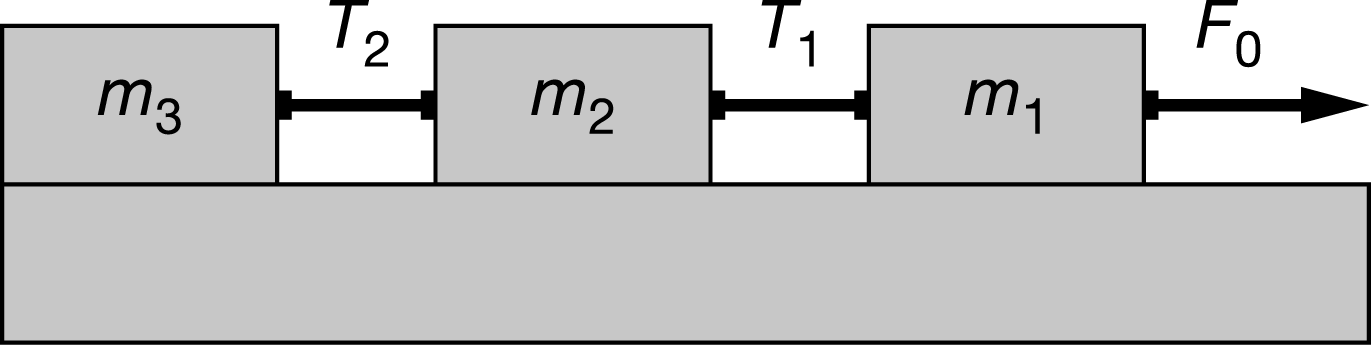
center

Three blocks are connected by strings and pulled to the right by a force with magnitude , as shown in the figure above. All frictional forces are negligible. The tension in the right and left strings have magnitudes and , respectively. Taking the positive direction to be toward the right, which of the following is a correct equation of motion for the block of mass?

If the acceleration is derive an expression for , , and in terms of , , , and any universal constants.


Acceleration Systems

center

Boxes are pulled by ropes along frictionless surfaces, accelerating toward the left. All of the boxes are identical, and the accelerations of all three systems are the same.

Rank the tensions in the ropes. Explain your reasoning


Accelerating Systems

In both cases a spaceship is pulling two cargo pods, one empty and one full. At the instant shown, the speed of the pods and spaceships is 300 m/s, but they have different accelerations as shown. All masses are given in terms of M, the mass of an empty pod.

Will the tension at point S in the tow rod be (i) greater in Case A, (ii) greater in Case B, or (iii) the same in both cases? Find the tension in each rope to help.


With your table

AP Workbook 2.K


In each case shown below, a box is sliding along a horizontal surface. There is friction between the box and the horizontal surface. The box is tied to a hanging stone by a massless rope running over a massless, frictionless pulley. All these cases are identical except for the different initial velocities of the boxes.

center

Rank the magnitudes of the accelerations of the boxes at the instant shown. Explain your ranking


center

center