Each time we use the mallet, let it bounce. (Don’t use the mallet like a bulldozer.)
Your goal: summarize the relation between taps and motion in as few statments as possible
On the next slide there is a list of statements. Decide if they the statement is true or false and then support that claim with evidence from the simulation and reasoning based on our models of motion and forces.
You can do this in 2 sentences
| Type of Force | Symbol | When is this force present? | In which direction is this force? | Field or Contact Force? |
|---|---|---|---|---|
| Force | ... | ... | ... | ... |
| Type of Force | Symbol | When is this force present? | In which direction is this force? | Field or Contact Force? |
|---|---|---|---|---|
| gravitational | Two objects with mass interact. One object is often the Earth. | Toward the center of Earth (or other large object) | Field (mediated by gravitational fields) |
| Type of Force | Symbol | When is this force present? | In which direction is this force? | Field or Contact Force? |
|---|---|---|---|---|
| electric | Two objects with electric charge interact. | Along line connecting the two objects (attraction or repulsion) | Field (mediated by electric fields) |
| Type of Force | Symbol | When is this force present? | In which direction is this force? | Field or Contact Force? |
|---|---|---|---|---|
| magnetic | Two objects with magnetic poles interact. | Along line connecting the two objects (attraction or repulsion) | Field (mediated by magnetic fields) |
| Type of Force | Symbol | When is this force present? | In which direction is this force? | Field or Contact Force? |
|---|---|---|---|---|
| normal | Two solid surfaces compress one another | Perpendicular to the surface | contact |
| Type of Force | Symbol | When is this force present? | In which direction is this force? | Field or Contact Force? |
|---|---|---|---|---|
| tension | An object (often a rope) gets stretched | Along the rope (or rope-like object) | contact |
| Type of Force | Symbol | When is this force present? | In which direction is this force? | Field or Contact Force? |
|---|---|---|---|---|
| friction | Two surfaces “catch” on one another and shear each other | Parallel to the surface | contact |
| Type of Force | Symbol | When is this force present? | In which direction is this force? | Field or Contact Force? |
|---|---|---|---|---|
| Buoyant | Upward force exerted by a fluid that opposes the weight of an immersed object | Upwards | contact |
| Type of Force | Symbol | When is this force present? | In which direction is this force? | Field or Contact Force? |
|---|---|---|---|---|
| lift | Air (or other fluid) pushes an object up | Up (opposite the direction of the gravitational force exerted on the object) | contact |
| Type of Force | Symbol | When is this force present? | In which direction is this force? | Field or Contact Force? |
|---|---|---|---|---|
| thrust | Air (or other fluid) pushes an object along the direction of motion | Along the direction of motion | contact |
| Type of Force | Symbol | When is this force present? | In which direction is this force? | Field or Contact Force? |
|---|---|---|---|---|
| drag | Air (or other fluid) pushes an object opposite the direction of motion | Opposite the direction of motion | contact |
| Type of Force | Symbol | When is this force present? | In which direction is this force? | Field or Contact Force? |
|---|---|---|---|---|
| Applied | Any other generic push or pull not listed above | Depends on context | contact |


Design an experiment(s) to find a mathematical relationship between those variables and acceleration
Consider:
Create a mathematical model relating mass, force, and acceleration.
Structure:
Questions to ask peers
Two giant holiday ornaments are hanging on Mr. Porter's front porch as show in the diagram to the right.
In another episode of Don't Do This At Home, Jason secures a strong cable to two dead trees in the woods behind his home and attempts to jump-start his tight-rope walking career. His first attempt ends in the rather precarious position shown in the diagram. The rope makes an angle of 10° with the horizontal. Jason has a mass of 70 kg. Determine the tension in the cable.
Tarzan, much to his dismay, gets his loincloth stuck on a branch. He’s left hanging with the vine pulling upward at a
Draw a FBD and vector addition diagram for the fan cart for the following three situations:
A person who weighs 500 N is standing on a scale in an elevator. The elevator is identical in all cases. The velocity and acceleration of the elevators at the instant shown are given.


** From NYS Regents Physics Reference Tables
How do Kinetic

Consider the free-body diagram for an object accelerating across a surface. The object has a mass of 2.12-kg. There is a forward thrust force of 50.0 N. The coefficient of friction between the object and the surface is 0.365. Determine the …

Determine the coefficient of static friction between your block and a two flat surfaces in the classroom.
Which surface will have a greater coefficient of friction?

Component of gravity perpendicular to incline
Component of gravity parallel to incline
**if you can't find these with ease using trig, you MUST memorize those equations
Lab partners Anna Litical and Noah Formula placed a 0.25-kg glider on their air track and inclined the track at 10.4° above the horizontal. Use the structure provided at the right to determine the …
The image shows our Einstein action figure sitting on a slab of wood coated with plastic tape. The angle at which Einstein slip's is


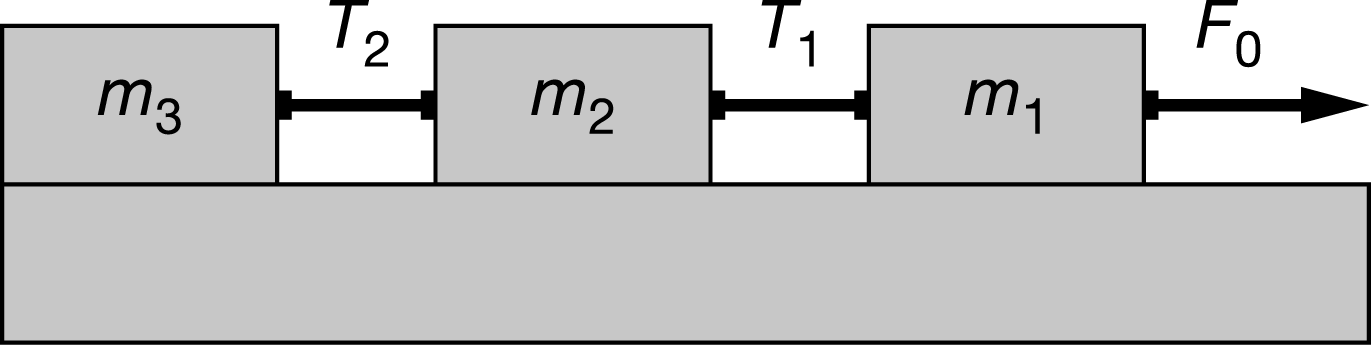
Three blocks are connected by strings and pulled to the right by a force with magnitude
If the acceleration is

Boxes are pulled by ropes along frictionless surfaces, accelerating toward the left. All of the boxes are identical, and the accelerations of all three systems are the same.
Rank the tensions in the ropes. Explain your reasoning
In both cases a spaceship is pulling two cargo pods, one empty and one full. At the instant shown, the speed of the pods and spaceships is 300 m/s, but they have different accelerations as shown. All masses are given in terms of M, the mass of an empty pod.
Will the tension at point S in the tow rod be (i) greater in Case A, (ii) greater in Case B, or (iii) the same in both cases? Find the tension in each rope to help.
In each case shown below, a box is sliding along a horizontal surface. There is friction between the box and the horizontal surface. The box is tied to a hanging stone by a massless rope running over a massless, frictionless pulley. All these cases are identical except for the different initial velocities of the boxes.

Rank the magnitudes of the accelerations of the boxes at the instant shown. Explain your ranking